Day 2
August 6, 2006
| Today the plan is to cover the geyser region of Yellowstone national park. Even though the whole park is a geologically active area, it is the region between Oldfaithful and Norris basin where you see most of the gysers and hot springs.In yellowstone one important tip to beat the crowd is to rise with the sun. Since all the tour buses and visitors start pouring in after 10 am, some of the well known places like Oldfaithful, Artist point can get very crowded. So it is always advisable to visit these places early in the morning to beat the crowd and enjoy the scenery all by yourself.As planned we checked out from room in Grant Village at 6:30 am, had our breakfast at the general store where you can get good breakfast at reasonable rate. | |
| Kepler Cascades: Driving west from Grant Village, the first point of interest that you encounter is Kepler Cascade. This is a beautiful place and with the morning fog and the cascade below, it is really worthwhile spending at least 30 min here. |  |
| Old Faithful Area: We reached the parking lot of Oldfaithful area at 7:30 am (17 miles from Grant Village). The first thing to do is to visit the visitor center and check the eruption timing of all the geysers. Also check out the timing of all the ranger led tours in the area. |  |
| It is always advisable to attend the ranger led programs/tours if available. That is the best way to learn more about the place especially in Yellowstone. We decided to see the South Section (map of south section ) which also includes Oldfaithful geyser in the morning and then come back at 5:30pm to attend the ranger led tour to see all the geysers in the Northen section(map of North section). | |
| Old Faithful Geyser: As I mentioned earlier, it is better to be at oldfaithful geyser early in the morning to beat the crowd. OldFaithful geyser erupts every 90 min. The approx eruption time of all the geysers can be obtained at visitor center. | 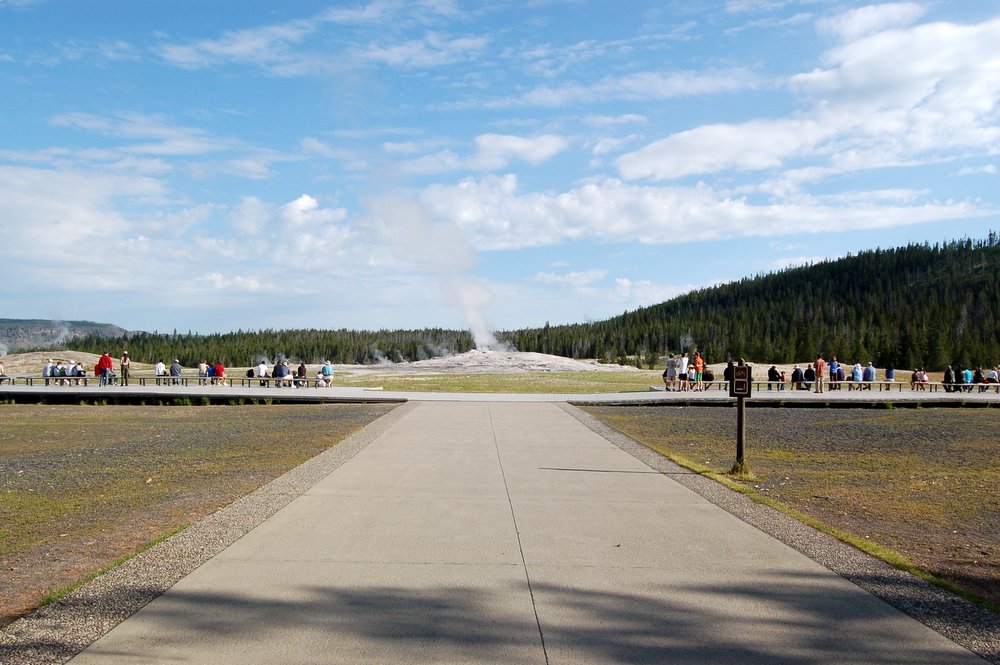 |
| Old Faithful erupts more frequently than any of the other big geysers, although it is not the largest or most regular geyser in the park. Its average interval between eruptions is about 91 minutes, varying from 65 – 92 minutes. An eruption lasts 1 1/2 to 5 minutes, expels 3,700 – 8,400 gallons (14,000 – 32,000 liters) of boiling water, and reaches heights of 106 – 184 feet (30 – 55m). It was named for its consistent performance by members of the Washburn Expedition in 1870. Although its average interval has lengthened through the years (due to earthquakes and vandalism), Old Faithful is still as spectacular and predictable as it was a century ago. | |
 |
The boardwalk near Oldfaithful is very quiet before 8 am and it is very pleasant to walkaround the area with a coffee. Also there are fewer than a dozen people on the Oldfaithful benches and you can enjoy the early |
| post sunrise eruption of the day without rubber-necking for a good view. After watching the geyser, we decided to take a stroll at the boarded Oldfaithful geyser loop which is 0.7 miles long. It is worth taking this hike and in the morning with mist and steam all aroubd, it is very relaxing. List of Trails or walkways from Oldfaithful visitor center
Check out the southern and Northen section map for a view of the area. |
|
| After our small hike, we stopped at the historic OldFaithful inn. Built during the winter of 1903-04, the Old Faithful Inn was designed by Robert C. Reamer, who wanted the asymmetry of the building to reflect the chaos of |  |
| nature. The lobby of the hotel features a 65-foot ceiling, a massive rhyolite fireplace, and railings made of contorted lodgepole pine. Wings were added to the hotel in 1915 and 1927, and today there are 327 rooms available to guests in this National Historic Landmark. | |
| Since we had decided to attend the ranger led tour in the evening to see geysers in the Northern section, we decided to proceed north from Oldfaithful to madison and Norris Basin. On the way, there are lot of points of interest that must be seen. | |
| Biscuit Basin: Three miles north of Old Faithful is Biscuit Basin, named for the unusual biscuit-like deposits formerly surrounding Sapphire Pool. Following the 1959 Hebgen Lake earthquake, Sapphire erupted, and |  |
| the “biscuits” were blown away. Other notable colorful features in the basin are Jewel Geyser, Shell Geyser, Avoca Spring, and Mustard Spring. | |
 |
 |
| Midway Geyser Basin: Next stop is Midway geyser basin. This geyser basin, though small in size compared to its companions along the Firehole River, holds large wonders for the |  |
| visitor. Excelsior Geyser reveals a gaping crater 200 x 300 feet with a constant discharge of more than 4,000 gallons of water per minute into the Firehole River. Also in this surprising basin is Yellowstone’s largest hot springs, Grand Prismatic Spring. This feature is 370 feet in diameter and more than 121 feet in depth. | |
 |
 |
| Excelsior Geyser | Grand Prismatic Spring |
 |
 |
| Bacteria Mat | FireHole River |
| Firehole Lake Drive: Leave the Midway Geyser Basin and continue down the road to Firehole Lake Drive. Take this drive slowly, stopping often and lingering. Since Firehole Lake Drive is a one-way loop, if you want to see something again you must repeat the entire circuit. You will pass Great Fountain Geyser, which is predictable but has a very long interval; pass it by unless someone |  |
| who knows geysers confirms that an eruption is imminent, in which case stick around for the show. The most easily photographed geyser on Firehole Lake Drive is just a few yards down the road: White Dome Geyser. |  |
| It erupts frequently but unpredictably. I think I have waited perhaps 20-30 minutes at most for it to go off. Pink Cone Geyser and Firehole Lake are ahead, the last notable stops on Firehole Lake Drive. | |
| After completing the Firehole Lake Drive, continue down the road to the Fountain Paint Pot area, and walk the boardwalk. You’ll see several geothermal features including a constantly erupting geyser Clepsydra), hot springs and paint pots. |  |
| Firehole Canyon Drive: After completing the Firehole Lake Drive, you can take the Firehole Canyon Drive. This 2 mile drive takes you through the beautiful filehole canyon and you can also stop to see the scenic Firehole Falls. |  |
| Gibbon Falls: Continue on the road to Madison, bear right toward Norris, you will be following the Gibbon River now. You will come to Gibbon Falls after five miles after Madison; it is usually crowded here during midday, perhaps difficult to |  |
| find a parking spot. The view of the falls from the road on the bluff is poor. If you are adventurous, instead do this: park a few hundred yards downriver from the main viewing area, hop over the wall, descend the dirt slope to the river, walk up the river along the fisherman’s trail to the foot of the falls, and enjoy this view. | |
| Once you are done with Gibbon Falls, continue to Gibbon Meadows, which is a broad meadow area about five miles north of Gibbon Falls. The hope here is that you will see elk, they are often in the meadow. If you arrive to a line up of cars, elk are likely the cause of the traffic. If there are elk here, great, stop and admire them while you can. You will likely see more during your visit to Yellowstone but in the event you do not, you want to get a good look now (a bird in hand…). | |
| As you proceed further from Gibbon meadows, you pass through terrace springs, Artists Paintpots(1 mile hike- highly recommended) and finally reach Norris Basin Area. | |
| Norris Basin: Norris Geyser Basin is the hottest, oldest, and most dynamic of Yellowstone’s thermal areas. The highest temperature yet recorded in any geothermal area in Yellowstone was measured in a scientific drill hole at |  |
| Norris: 459°F (237°C) just 1,087 feet (326 meters) below the surface! There are veryfew thermal features at Norris under the boiling point (199°F at this elevation). Norris shows evidence of having had thermal features for at least |  |
| 115,000 years. The features in the basin change daily, with frequent disturbances from seismic activity and water fluctuations. The vast majority of the waters at Norris are acidic, including acid geysers which are very rare. Steamboat Geyser, the tallest geyser in the world (300 to 400 feet) and Echinus Geyser (pH 3.5 or so) are the most popular features. The basin consists of three areas: Porcelain Basin, Back Basin, and One Hundred Springs Plain. Porcelain Basin is barren of trees and provides a sensory experience in sound, color, and smell; a 3/4 mile dirt and boardwalk trail accesses this area.Back Basin is more heavily wooded with features scattered throughout the area; a 1.5 mile trail of boardwalk and dirt encircles this part of the basin. One Hundred Springs Plain is an off-trail section of the Norris Geyser Basin that is very acidic, hollow, and dangerous. Travel is discouraged without the guidance of knowledgeable staff members. The area was named after Philetus W. Norris, the second superintendent of Yellowstone, who provided the first detailed information about the thermal features. | |
| After hiking the two trails in Norris Basin and also a stop at the museum, we decided to head back to the OldFaithful area to take the ranger lead tour of the Oldfaithful geysers starting at 5:30 pm from Castle Geyser. | |
Day1
August 5, 2006
| Day 1: We reached Billings at noon(late by 1 hour). Billings airport is small and can be bit crowded when planes land simultaneously. It took us 45 min to finally get a car and come out of the airport.( Fortunate enough to get a free upgrade to infinity G35). Finally we started driving west from billings (90 w) at 1:30 pm. Destination was Grants Village Yellowstone via Beartooth Highway. There are two ways to reach Yellowstone from Billings. One way is to drive west on 90 and take 89 south to north entrance of YNP. Other one is to drive through the Beartooth Highway (212) to reach the north-east entrance of YNP. Total distance approx 200 miles. Going west on 90, take US-212 exit 434 to Laurel/Red Lodge. This is a two lane highway but speed limit is 70 mph. Nothing much is on the way until you reach Red Lodge.Red Lodge lies near the eastern end of the scenic byway. This small mountain resort community is tucked into Rock Creek Valley at 5,555 feet elevation. There are festivals and celebrations to enjoy, interpretive nature trails, and cross-country and alpine skiing opportunities. A number of competitions, such as the Peaks to Prairie Triathlon and the Beartooth Run, attract athletes and spectators. The downtown is pleasant, with nice shops. | ||||||||||
| Beartooth Highway: The most scenic drive of this highway is between Red Lodge and Cooke city. As we continued our drive, the scenery started unfolding before our very eyes. Arguably this is the most beautiful drive we have ever passed through. The snow clad peaks, clear lakes and the wild flowers that dot these meadows take you to a totally different world which is so pristine, quiet and |  Beartooth Highway |
|||||||||
| beautiful. This is one of the beautiful view you get as you drive through this road. Below is few pictures of the meadows that you pass.I hope these pictures would atleast give you an idea as to what you can expect on the drive. Click here to see more pictures from beartooth mountain drive. | ||||||||||
|
||||||||||
| It took us almost 3 hours to cover a distance of 68 miles between Red Lodge and CookeCity with numerous stops on the way. We reached the north-east entrance of Yellowstone at 5:30 pm. Our final destination for the day was Grants Village which is near the south entrance (see map). This 82 miles drive within the park took us through tower falls,canyon, Hayden valley ,lake area.Although it was a long drive, it was definitely worth it. Since it was still |  North-East entrance of YNP |
|||||||||
| bright (sun sets at 9:45 pm here), we decided to see at least couple places on the way (so that we don’t have to visit those places again). The fist stop was at Lamar valley. Even though I had planned to come here later in the trip, we did stop at few places to see bison grazing in the evening sun. Next stop was near canyon, to see an elk grazing along the road side. | ||||||||||
| Hayden Valley: The most beautiful place on the way was Hayden valley. This is 10 miles south of canyon junction and with the evening sun lighting up the valley from the west, the scenery was just picture perfect. We stopped here for almost 30 min savouring the natural beauty. | ||||||||||
 |
 |
|||||||||
| Hayden Valley | Hayden Valley 2 | |||||||||
| Mud Volcano: Our next stop was Mud Volcano area. This is one of the most geologically active area with lot of thermal activity. Click here to read more about Mudvolcano and Hayden Valley. |  Mud volcano |
|||||||||
| Grant Village: Finally we reached Grant village at 8 pm . It was indeed a long day which began at 3:30 am in the morning. We registered at the Grant Village visiting center and checked into our room. At $115 per night, it is a modest lodge with no AC, but the facilities are good. Read more about Grant Village at Grant Village . | 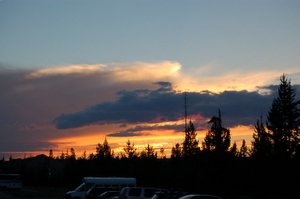 Evening sky in Grant village |
|||||||||
| We had our dinner at the lake village restaurant, located right next to the Yellowstone lake. It is a nice restaurant with good menu choice (Click here to see the menu at Grant Village restaurant). After dinner, we decided to attend the ranger led program at the Grant village amphitheatre, but we had to beat a hasty retreat to escape from the mosquitoes (bug repellent is a must). | ||||||||||


 All about Yellowstone